Road safety information reviewed
Stopping distance is the ground your car covers from the moment you recognise a need to stop until it comes to a halt. Part of that distance happens before you press the brake. The rest happens while the car is slowing down.
Understanding those two parts helps explain why attention, speed, tyres and wet roads all matter. As you develop your driving skills with Coastwide, your instructor can help connect the explanation to observation and the space you leave in everyday driving.
Reaction distance plus braking distance
Before braking
You need time to notice a hazard, recognise that you need to stop and respond. The car keeps moving during that reaction time. At a higher speed, it covers more ground during the same interval.
While braking
Once you apply the brakes, the car still needs distance to slow to a stop. Speed, available grip and the condition of the vehicle affect that distance.
A short calculation makes the reaction part easier to picture. At 60 km/h, a vehicle travels about 16.7 metres each second. With the 1.5-second reaction assumption used in Queensland's example, it travels about 25 metres before braking starts: 60 ÷ 3.6 × 1.5.
The calculation describes a chosen example. It does not measure your personal reaction time or predict a particular emergency.
How wet and dry examples compare
Queensland Transport and Main Roads publishes the following model for an average family car. At 60 km/h, its total is 45 metres on a dry road and 54 metres on a wet road. The extra nine metres comes from the longer braking distance in that model.

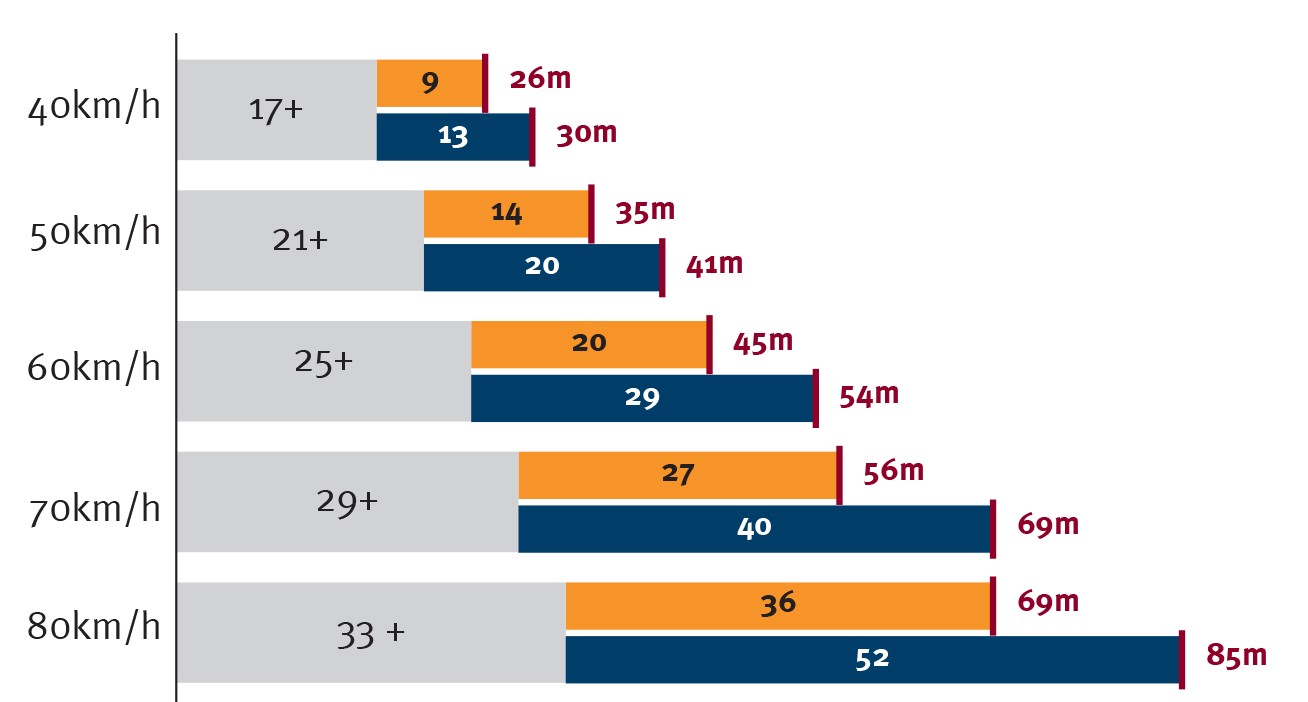 Transport and Main Roads stopping-distance illustration. The figures are examples under stated conditions.
Stopping distances in the TMR example
| Speed |
Reaction |
Dry braking |
Dry total |
Wet braking |
Wet total |
| 40 km/h |
17 m |
9 m |
26 m |
13 m |
30 m |
| 50 km/h |
21 m |
14 m |
35 m |
20 m |
41 m |
| 60 km/h |
25 m |
20 m |
45 m |
29 m |
54 m |
| 70 km/h |
29 m |
27 m |
56 m |
40 m |
69 m |
| 80 km/h |
33 m |
36 m |
69 m |
52 m |
85 m |
Why the result can change
A driver who notices a developing problem early has more time to respond. Distraction or tiredness can delay that response. Looking only at the bumper directly ahead leaves you less aware of what is developing further along the road.
Tyre condition and pressure, brakes, vehicle load, road surface and gradients also affect the situation. On a wet road, reduce speed as needed and leave more room. Queensland's wet-weather guidance explains how to adjust your driving when grip or visibility is reduced.
Notice that the reaction distance is the same in the wet and dry rows above. That is a modelling choice which holds reaction time steady to show the braking difference. It does not mean rain, spray or poor visibility cannot make a hazard harder to recognise.
Turn the explanation into useful habits
During a lesson or supervised drive, discuss what is happening beyond the car immediately ahead. Notice traffic slowing, a changing signal or a vehicle waiting to turn. Practise responding early and smoothly while keeping a suitable gap.
Our safe following distance guide explains spacing and observation in more detail. Use it alongside this stopping-distance explanation: a time gap is a practical driving tool, while the figures here illustrate why space and speed matter.