Published
A turning refresher
It may have been years since you last opened the road rules handbook. Turning is something we do on almost every drive, but lane position, painted islands and give-way rules can still cause uncertainty. Here is a refresher for car drivers, using the diagrams from our original article.
Set up for a left turn
On a road without multiple lanes, approach and enter the intersection as near as practical to the far left side. On a multi-lane road, use the left lane unless arrows or another applicable rule allow a different lane. An obstruction can change which lane you use.
Where the multi-lane road has a slip lane, make the left turn from it unless an obstruction prevents you entering it. Check for people crossing the slip lane and give way as required. You must also give way to traffic on the road you are entering, apart from vehicles making a U-turn.
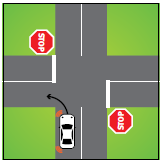 Approach a left turn from near the left side.
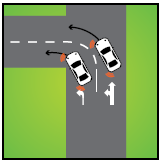 Road arrows can permit a left turn from more than one lane.
Choose the correct position for a right turn
- From a two-way road without multiple lanes: approach close to, parallel with and left of the centre line or median. If there is no line, use the centre of the road as your reference.
- From a one-way road without multiple lanes: approach as near as practical to its far right side.
- From a multi-lane road: normally use the right lane. Follow lane arrows where they allow or require another turning lane, and account for obstructions and special-purpose lanes.
- Through the turn: follow marked turn lines. When entering a two-way road, keep left of its centre.
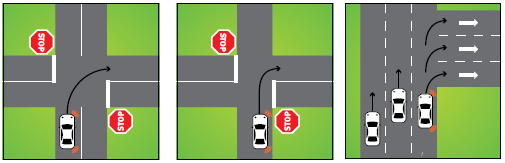 Different road layouts need different starting positions.
Turning into a road with several lanes
When turning from a single lane, you can generally choose the receiving lane unless marked turn lines require a particular path. Give way to vehicles in the lane you are entering, and to people crossing the road you are turning into. Choose a safe path before you begin rather than drifting across lanes during the turn.
When there are no turn lines
For a right turn at an intersection without turn lines, pass as near as practical to the right of the intersection's centre. Give-way requirements still apply. A turning path does not give you priority over an approaching vehicle.
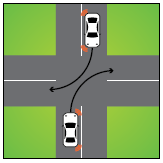 Use the centre of the intersection to guide an unmarked right turn.
Read Queensland's giving-way guidance for examples involving oncoming vehicles, pedestrians, bicycles and personal mobility devices.
Check whether a U-turn is allowed
You need a clear view of approaching traffic and enough room to turn without obstructing its free movement. Give way to every other vehicle and pedestrian, including drivers facing a stop or give way sign.
At traffic lights, a U-turn is only permitted where a sign says so. Other signs, centre lines, painted islands and crossing rules can also prohibit the manoeuvre. Check the full Queensland U-turn rules before choosing a location.
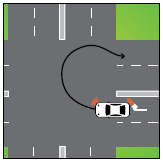 A driver making a U-turn must give way to other road users.
Understand painted islands before crossing them
A painted island surrounded by a single continuous line can be crossed for up to 50 m to enter or leave the road, or to enter a turning lane that begins immediately after it. This is a limited exception, not permission to drive along any painted island.
The enter-or-leave-the-road exception does not apply to an island separating traffic moving in the same direction where roads merge, or to an island separating a slip lane. Different rules also apply to islands surrounded by double continuous lines. Check the official road marking examples and section 138 of the Queensland Road Rules.
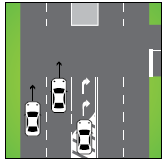 The original handbook example shows an island immediately before a turning lane.
The diagrams were included in the April 2019 edition of Your keys to driving in Queensland. The explanations above have been checked against current official guidance. For the full rules, including special cases for long vehicles and other road users, use the current Queensland driving handbook.